
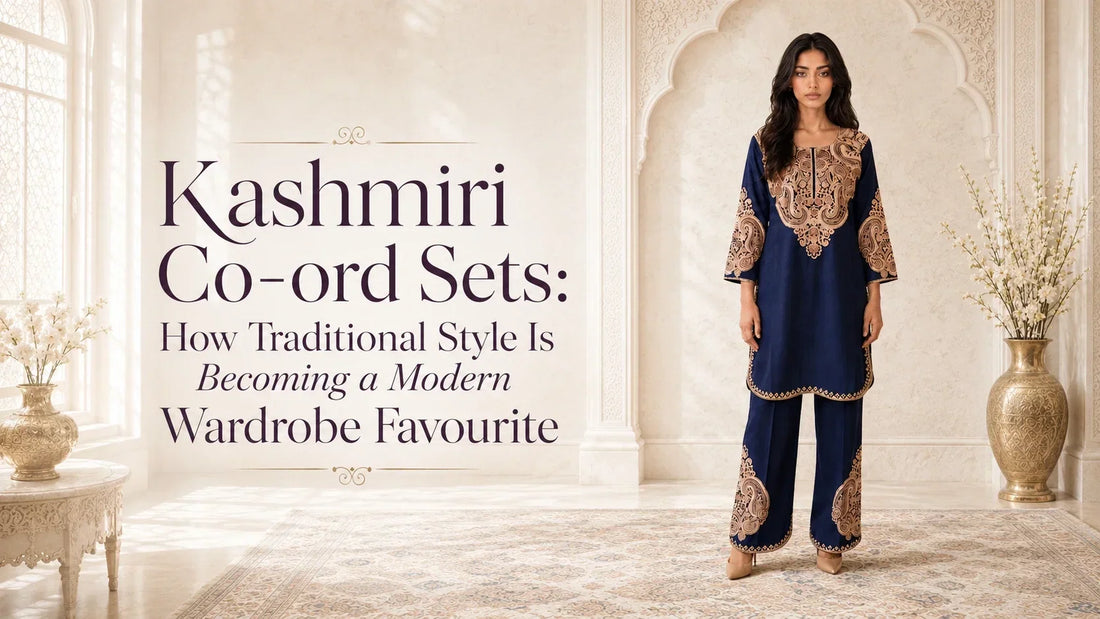
Many women enjoy traditional clothing but do not always want an outfit that feels heavy, formal, or limited to special occasions. They want something easy to wear, simple to style, and still connected to Indian craft.
A Kashmiri co-ord set fits this need well. It brings together matching separates, regional embroidery, and modern shapes that can work for office days, family lunches, festive gatherings, and casual outings. The appeal lies not only in how the outfit looks, but also in how easily it fits into everyday dressing.
What Is a Kashmiri Co-ord Set?
A Kashmiri co-ord set is a matching top-and-bottom outfit that combines a modern coordinated silhouette with Kashmiri-inspired embroidery, motifs, colors, or textile details.
The term “co-ord” means coordinated pieces. What makes the Kashmiri version different is its stronger craft identity. Embroidery may appear around the neckline, sleeves, borders, front panels, or trouser hems rather than being spread across the entire outfit.
This selective placement is important. It keeps traditional details visible without making the outfit feel overly formal.
A good co-ord also gives more than one styling option. You can wear the full set together, or pair the top or trousers separately with other wardrobe pieces.
What Makes Kashmiri Co-ord Sets Different from Regular Co-ords?
Regular co-ords often rely on matching colors, prints, or cuts. Kashmiri-inspired co-ords add a stronger connection to regional design through embroidery and traditional motifs.
|
Feature |
Regular Co-ord |
Kashmiri Co-ord |
|
Main focus |
Matching silhouette |
Craft plus matching silhouette |
|
Detailing |
Prints or minimal work |
Often embroidery-led |
|
Motifs |
Mostly contemporary |
May feature floral or paisley details |
|
Styling |
Modern and casual |
Traditional and contemporary |
|
Occasion |
Everyday to dressy |
Everyday to festive |
Common design elements can include:
-
Kashmiri-inspired embroidery
-
Floral or paisley motifs
-
Decorative necklines
-
Detailed cuffs or borders
-
Coordinated trousers
-
Tone-on-tone or contrast threadwork
One detail shoppers should not overlook is embroidery balance. A heavily worked garment can look beautiful, but it may be harder to repeat often. Lighter or tone-on-tone work usually fits more easily into office and everyday wardrobes.
How Does Traditional Kashmiri Craft Fit into Modern Co-ords?
Traditional craft does not need to disappear for a garment to feel modern. The more effective approach is to place traditional details on simpler shapes.
A useful way to understand this is:
-
Craft: embroidery and regional motifs
-
Silhouette: cleaner, straighter, more contemporary cuts
-
Coordination: matching pieces that are easy to style
-
Versatility: the option to wear pieces together or separately
A shorter top, straight trousers, relaxed sleeves, or a cleaner neckline can make traditional details feel more practical for everyday use.
It is also important not to treat all Kashmiri embroidery terms as identical. Aari, Sozni, Tilla, and other regional craft traditions have their own characteristics. Shoppers should check the actual product description instead of assuming every embroidered Kashmiri garment uses the same technique.
This distinction matters for both authenticity and informed buying.
Why Are Kashmiri Co-ord Sets Becoming Popular?
Their popularity comes from the mix of convenience, craft, and repeat wear.
Women are increasingly looking for outfits that feel special without requiring too much styling effort. A coordinated set solves this by creating a complete look straight away.
Other practical reasons include:
-
Matching separates reduce styling time.
-
Embroidery gives the outfit more personality.
-
Modern cuts make traditional design easier to wear.
-
Different fabrics suit different seasons.
-
The top and trousers can often be restyled separately.
A co-ord can therefore work as one full outfit plus two separate wardrobe pieces.
For example, you can wear the embroidered top later with plain trousers or denim, while pairing the matching bottom with a simple solid top. This makes the purchase more useful than an outfit that works only in one fixed combination.
Are Kashmiri Co-ord Sets Only for Winter?
No. The season depends more on fabric, lining, and construction than on the style name.
Lighter fabrics can suit warmer weather, while wool and heavier materials are more practical in colder months.
A simple guide is:
-
Cotton or light blends for warmer days
-
Wool for autumn and winter
-
Velvet for cooler festive occasions
-
Heavier embroidery for evening or event wear
Lining is also worth checking. A lightweight outer fabric can still feel uncomfortable if the inner lining is thick or non-breathable.
Choosing by season should therefore involve both the outer fabric and the garment construction.
Where Can You Wear a Kashmiri Co-ord Set?
The amount of embroidery and the fabric usually decide how formal the outfit feels.
For office wear, cleaner designs with subtle embroidery and neutral shades are easier to repeat.
For casual lunches or family gatherings, soft colors and moderate detailing can give a polished look without feeling overdressed.
For festive occasions, richer fabrics, deeper colors, or more detailed embroidery can create a stronger visual impact.
A helpful way to judge embroidery level is:
-
Minimal or tone-on-tone work for office and daily wear
-
Moderate embroidery for family and social occasions
-
Rich contrast embroidery for festive events
This makes it easier to choose a set based on real use rather than only on how attractive it looks in photographs.
How Do You Style and Choose the Right Kashmiri Co-ord Set?
Fit should come first. One common co-ord problem is that the top fits well while the trousers do not.
Before buying, check:
-
Bust measurement
-
Waist measurement
-
Hip measurement
-
Top length
-
Trouser length
-
Fabric composition
-
Care instructions
Don't rely only on S, M, or L, because the upper and lower body may need different proportions.
For styling, let the embroidery decide how much else the outfit needs. Detailed necklines usually work better with small earrings and simple footwear.
An embroidered top can also be paired with plain trousers, while a shawl or stole can add warmth in cooler weather without changing the outfit completely.
For women who prefer clothing that combines craft with practical styling, Pashmal’s approach to modern Kashmiri dressing reflects this balance between traditional detail and contemporary wearability.
FAQ’s
Can Kashmiri co-ord pieces be worn separately?
Yes. Many sets can be restyled as separates. Pair the embroidered top with plain trousers or denim, or wear the matching bottoms with a simple solid top.
How should embroidered co-ord sets be stored?
Store them clean, dry, and away from strong sunlight. Avoid tightly compressing heavily embroidered areas for long periods.
Should I buy a larger size for an embroidered co-ord?
Not automatically. Compare your actual bust, waist, and hip measurements with the garment size chart before choosing.
Can I wear a dupatta with a Kashmiri co-ord set?
Yes. A simple dupatta works well when the outfit already has detailed embroidery, while richer options can suit festive occasions.


