
You just bought a soft, beautiful shawl, or maybe you are about to. Then a small worry creeps in. Is it really pashmina, or did someone sell you a clever copy?
This worry is common. The pashmina market is full of shawls that look and feel expensive but are made from blended or synthetic fibers. Many buyers only find out the truth after asking friends, reading forums, or doing their own research.
This guide walks you through what a pashmina label actually means, why the famous ring test is not enough on its own, and what checks actually help you know the truth. By the end, you will know how to look at a shawl the way an experienced buyer does.
What Is a Pashmina Label?
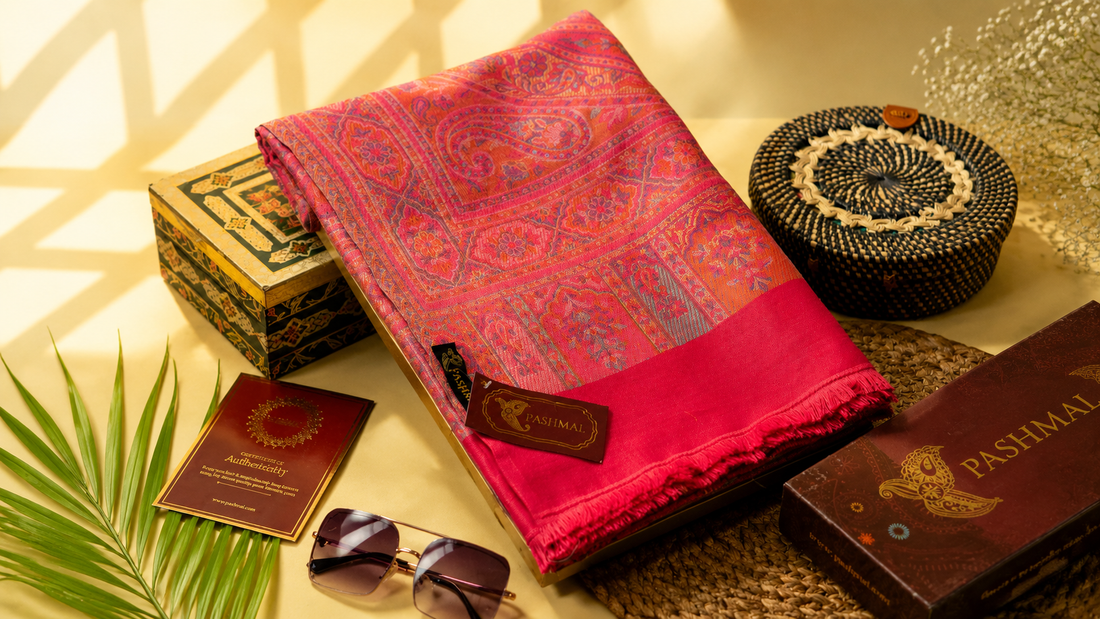
A pashmina label is the small tag stitched into a genuine shawl. It usually carries GI, or Geographical Indication, details that confirm where the shawl was made and how.
This certification is not just a marketing word. It comes from India's Geographical Indications Act, registered in 2005 under GI Registration Number 46. The label often includes a serial number and, in newer versions, a QR code you can scan.
Here is something many buyers do not realize. A label that says "100% pashmina" printed on cheap fabric is not the same as a certified GI tag. Anyone can print words on a tag. Very few sellers can legally attach an official GI mark, because it is tied to a registered process and specific artisans.
Counterfeit labels often give themselves away on close inspection. Look for uneven or blurry font, stitching that looks glued rather than sewn through the fabric, and a serial number that repeats across multiple shawls in the same shop. A genuine label is stitched cleanly along all four edges and carries a number that appears nowhere else.
Does the Ring Test Prove a Pashmina Is Real?
No, it does not. Passing the ring test only shows that a fabric is thin enough to compress and slide through, not what the fabric is actually made from.
Many shopkeepers still show customers this test as final proof. They pull the folded shawl through a small ring and say, "See, it's real." The truth is more complicated than that demonstration suggests.
In practice, several other materials pass this test just as easily. Fine silk can slide through a ring. So can softened viscose and certain synthetic blends, especially after a fabric conditioner treatment. A shop can genuinely believe their test proves something, while the shawl in your hand is not pashmina at all.
This is one of the most common misunderstandings in the pashmina trade. Sellers are not always trying to trick you. Many honestly believe the ring test is reliable because it was passed down as tradition, shop to shop, for decades.
A better way to think of the ring test is as a first, quick filter. If a shawl fails to pass through a ring, you can be fairly confident it is not genuine pashmina. If it does pass, that alone tells you very little.
What Is a GI Tag on Pashmina, and How Do You Verify It?
A GI tag on pashmina is a legal certification confirming the shawl was made in the Kashmir or Himalayan region, using traditional hand-spinning and hand-weaving methods. In simple terms, pashmina is a specific, finer subtype of cashmere, not a separate fiber altogether, and the GI tag is what ties a shawl back to that specific origin.
Newer GI labels use a tamper-proof, break-to-remove design. The tag cannot be peeled off one shawl and reattached to another without visible damage. Many also carry a QR code linked to the artisan, the product, and the specific batch.
To verify one, follow these steps.
- Look for the rectangular label stitched onto the shawl, usually around 20mm by 35mm in size.
- Look for the rectangular label stitched onto the shawl, usually around 20mm by 35mm in size.
- Note the unique serial number printed on it.
- Scan the QR code with your phone if one is present.
- Compare the details shown on screen with the physical shawl in your hands.
This step matters even more for buyers outside India. If you are ordering pashmina online from the UK, US, or the Middle East, you cannot touch or test the fabric before it arrives. A scannable, verifiable GI code becomes your main proof, since you cannot rely on the seller's word alone.
The Four-Layer Check for Authenticity
Instead of relying on a single test, buyers in the trade often use what is sometimes called a four-layer check, looking at the shawl from four different angles at once.
- Label: Does it carry a real GI tag with a working serial number or QR code?
- Fiber: Does it pass the ring test, and does a burnt thread from the fringe leave a fine, powdery ash with a smell like burnt hair, rather than melting like plastic?
- Weave: Are there slight, natural irregularities in the weave, rather than a perfectly uniform machine pattern? Genuine handloom pashmina often carries a diamond-style weave known as chashme-bulbul, while a printed jacquard pattern usually signals machine production.
- Behavior: Does the seller answer questions calmly, or grow defensive when you ask to test the fabric? A seller's reaction to your questions often reveals more than the fabric itself.
A quick static check adds one more data point. Rub two sections of the shawl together gently. Real pashmina generates little to no static, while many synthetic blends cling and crackle.
No single layer gives a complete answer by itself. When a shawl passes most of these checks together, your confidence in its authenticity rises sharply. At Pashmal, this is close to how our own sourcing works in practice. We look at label, fiber, and weave together before a shawl reaches our collection, rather than relying on any one test in isolation.
Pashmina vs. Cashmere vs. Shahtoosh
These three words get mixed up often, and the confusion is not always accidental. Some sellers use them loosely to make a product sound more special than it is.
Fiber |
Source |
Fiber Diameter |
Legal Status |
|
Pashmina |
Changthangi goat (Ladakh, India) |
12–16 microns |
Legal |
|
Cashmere |
Several goat breeds from various regions |
Slightly thicker than Pashmina; varies by breed |
Legal |
|
Shahtoosh |
Tibetan antelope (Chiru) |
Extremely fine (around 10–12 microns) |
Banned in most countries due to wildlife protection laws |
If a seller ever offers you "shahtoosh" as a luxury upgrade, treat it as a warning sign rather than a special deal.
How to Identify Pure Pashmina Shawls Before You Buy?
The right checks depend a little on how you are buying.
If you are buying in person in Kashmir or elsewhere in India, ask to see the label closely and request the ring and burn tests together, not just one of them.
If you are buying online within India, look for clear photos of the GI label and ask the seller directly for the serial number before you pay.
If you are buying from outside India, prioritize sellers who show a scannable QR-based GI label in their product photos, since you will not be able to test the fabric before delivery physically.
Across all three situations, one habit matters more than any single test. Pay attention to how the seller responds when you ask questions.
FAQ's
Can a fake pashmina have a real-looking label?
Yes, counterfeit tags can copy the appearance of a genuine label, including printed text and even fake serial numbers. Verifying the actual QR code or number against official records matters more than trusting the label's look alone.
Is machine-embroidered pashmina still authentic?
Embroidery method does not decide whether the base fabric is real pashmina. A shawl can have machine embroidery and still be genuine underneath, so check the fiber and label separately from the embroidery style.
What if a seller refuses to let me test the shawl?
Reasonable sellers usually allow a quick ring or burn test on a fringe thread, since it does not damage the shawl. Hesitation here is a fair reason to ask more questions before buying.
How do I check a pashmina GI tag from another country?
Look for a photo of the QR code before you buy, then scan it as soon as the shawl arrives to confirm the artisan and product details match what was listed.
Final Thoughts
Buying pashmina does not need to feel like guesswork. Once you understand what a label actually proves and why the ring test is only one small piece of the puzzle, you can walk into any shop or website with far more confidence.
If you would rather skip the back-and-forth entirely, look for sellers who are upfront about their GI verification process and happy to show you the label before you buy.


