
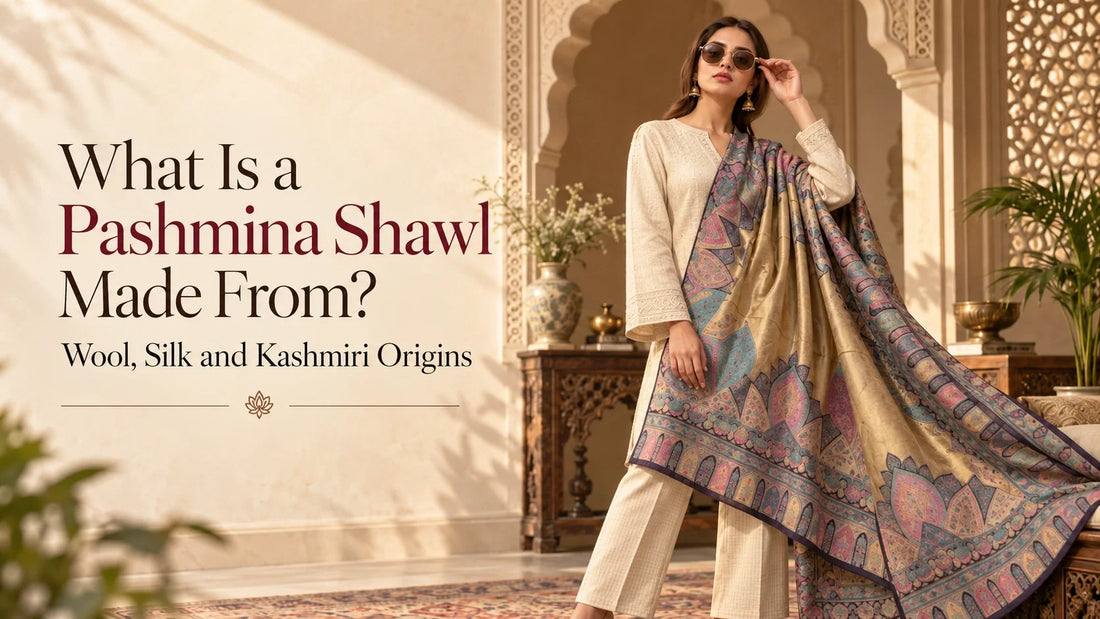
You find two shawls that both say "pashmina." One costs ₹1,500 and the other ₹18,000, yet they feel the same. So what are you really paying for?
It comes down to what a pashmina shawl is made from. Some are pure goat wool, some mix in silk, and some have no pashmina at all. Here's how each type differs, and how to check yours.
What Is a Pashmina Shawl Made From?
A real pashmina shawl is made from pashm, the soft undercoat of the Changthangi goat. "Pashm" is a Persian word for wool. In Kashmir, it refers to the goat's raw, unspun fiber.
Each fiber is only about 12-16 microns thick. Thin fibers trap warm air without adding weight, so pashmina feels light but stays warm. They also don't prick the skin, so real pashmina should never itch.
Where Does Pashmina Wool Come From?
Pashmina wool comes from goats in Ladakh, but Kashmir makes the shawl. Many buyers think the goats live in Kashmir. They don't.
Which Goat Gives Pashmina?
The Changthangi goat lives on the Changthang plateau in Ladakh, over 4,000 meters high, where winters fall to −40°C. Nomadic herders called the Changpa raise these goats. Each spring, the goats shed their winter coat and herders comb it out by hand. They do not shear the goats, and the goats are not harmed.
From Ladakh to Kashmiri Looms
One goat gives just 80 to 170 grams of fiber a year, and only about a third is fine enough for the best yarn. In Srinagar, the fiber is:
- Cleaned, with the coarse outer hair picked out
- Spun into yarn on a wooden wheel
- Woven on a handloom
- Washed, dyed and finished
A plain stole takes about 180 hours. Add Sozni embroidery or Kani weaving, and one shawl can take months. That's what you pay for.
Is Pashmina the Same as Cashmere?
Pashmina is a type of cashmere, but not all cashmere is pashmina. Cashmere comes from many goat breeds, mostly in China and Mongolia. Pashmina is the finest grade, from Ladakh's Changthangi goat, usually handmade in Kashmir.
|
Feature |
Pashmina |
Regular Cashmere |
Sheep Wool |
|
Source |
Changthangi goat, Ladakh |
Many goat breeds |
Sheep |
|
Fibre thickness |
12–16 microns |
Usually 15–19 microns |
Over 20 microns |
What Is a Pashmina and Silk Shawl?
A pashmina and silk shawl mixes pashmina yarn with silk, often about 70% pashmina and 30% silk. It still contains real pashmina, just not 100%.
Why Weavers Add Silk
Pashmina yarn is so fine it can snap on the loom. Silk is stronger, holds the weave together, and adds a soft shine.
When a Silk Blend Makes Sense
Silk lowers warmth a little, so a blend works best for:
- Weddings and evening events, where some shine looks right
- Mild winters, such as in Mumbai, Bengaluru, or Pune
- Draping over silk sarees and lehengas
For January in Punjab or the hills, choose 100% pashmina. And "pashmina silk" with no percentage on the label tells you very little.
What Is Faux Pashmina Made Of?
Faux pashmina looks and feels like pashmina but contains no pashmina. It is usually made from viscose (a soft fiber from wood pulp), acrylic, or fine sheep wool.
Faux is not the same as fake. A clearly labeled faux shawl is an honest, affordable product. It becomes fake only when viscose is sold as "pure pashmina."
India's labeling standard, IS 17269, sorts pashmina products into 100% pashmina, pashmina with silk, and pashmina mixed with other fibers. If a tag says "pashmina," ask what's inside.
Pure, Silk Blend or Faux: Which Should You Buy?
|
Type |
Best For |
What to Expect |
|
100% Pashmina |
Heirlooms, bridal trousseau, cold winters |
Highest price, warmest, matte look |
|
Pashmina and Silk |
Weddings, evening wear, mild winters |
Soft shine, a little less warmth |
|
Faux Pashmina |
Daily wear, travel, easy gifting |
Affordable, simple care |
A common mistake is buying pure pashmina for one wedding, then losing it to moths in a plastic bag. If you'll wear a shawl twice a year, a blend or faux piece may serve you better.
How Can You Check What Your Shawl Is Made Of?
Read the Label and GI Tag
A genuine Kashmiri pashmina shawl may carry a GI (Geographical Indication) tag with a QR code. The Pashmina Testing and Quality Certification Center in Srinagar tests shawls before issuing this tag. Scanning it shows the maker, origin, and raw material.
Some small weavers work outside this system, so a missing tag isn't proof of a fake. But if a seller claims GI, scan the code yourself.
Try a Few Home Checks
- Look at the shine. Pashmina has a soft, matte glow, while a plastic-like shine points to viscose.
- Hold it up to daylight. Handwoven pashmina shows a slightly uneven, airy weave.
- Burn one loose thread, away from the shawl. Pashmina smells like burnt hair and leaves soft ash. Synthetics melt into a hard bead.
Be careful with two popular tests. The ring test proves little, because thin silk and synthetics slip through too. And a burn test can't spot a silk blend, since silk also smells like burnt hair.
FAQ's
Is pashmina the same as Shahtoosh?
No. Shahtoosh comes from the endangered Tibetan antelope, and its trade is banned. Pashmina comes from domestic goats and is legal.
How should I wash a pashmina shawl?
Dry cleaning is safest. At home, use cold water and a mild baby shampoo, never wring it, and dry it flat in the shade.
How do I keep moths away from pashmina?
Fold it in muslin with neem leaves or cedar balls, and store it in a dry cupboard, never in plastic.
Can I wear a pashmina shawl in an air-conditioned office?
Yes. A light pashmina-silk stole adds warmth in a cold office without bulk.
Is a little pilling normal on pashmina?
Yes. A few bobbles can form where it rubs, like under a bag strap. Pick them off by hand, never with a razor.
A Final Word Before You Buy
Ask "what percentage?" before you ask "how much?" A seller who tells you the exact fiber mix is usually someone you can trust, no matter the price.
When you're ready, explore Pashmal's shawls and stoles and check the fabric details on each piece.


