
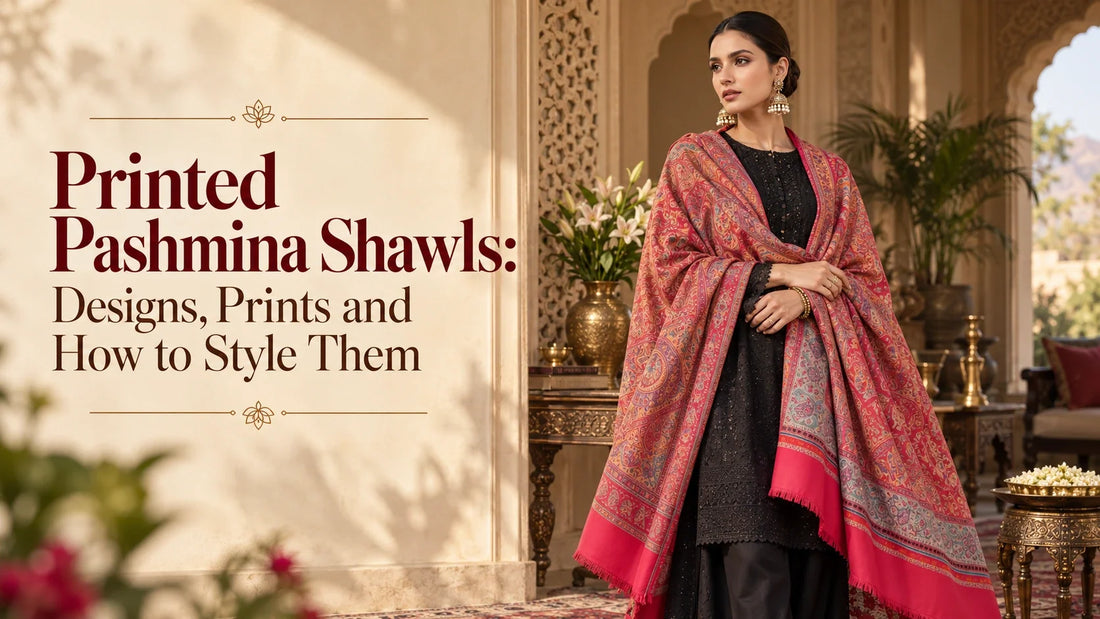
You find a lovely paisley shawl online labeled “pashmina” for ₹1,200. A near-identical one costs ₹15,000 in a Delhi shop. Which one is telling the truth?
A printed pashmina shawl can be a smart buy, once you know what you are looking at. This guide covers the fabric, the four main prints, how printed compares with woven and embroidered, and how to wear and wash one.
What Is a Printed Pashmina Shawl?
A printed pashmina shawl is a soft shawl with a pattern printed on top of the fabric after weaving.
Every printed shawl really has two labels: the fabric underneath and the print on top. The print tells you how the shawl looks. The fabric tells you how warm it will be, how it drapes, and how to wash it.
The fabric is usually one of these:
- Pure pashmina: under-wool of the Changthangi goat from Ladakh
- Blends: pashmina or wool mixed with silk
- Faux pashmina: soft fabrics such as viscose, made to feel like pashmina
Is Printed Pashmina Real Pashmina?
Sometimes, but rarely. Kashmir Pashmina has been a registered Geographical Indication (GI No. 46) since December 2005. A GI shawl uses 100% pashmina no thicker than 16 microns, hand-spun and hand-woven in Jammu and Kashmir, with a serial-numbered tamper-proof label.
As a rough guide, ₹1,000 to ₹2,000 usually means faux, around ₹5,000 often means a blend, and pure printed pashmina costs far more. Faux is a fair choice, as long as the tag says so.
Types of Prints on Pashmina Shawls
The four prints you will see most are floral, paisley, kalamkari, and digital. Floral and paisley are designs, meaning what the pattern shows. Kalamkari and digital are methods, meaning how the pattern is applied to the cloth.
Floral
Roses, lotuses, chinar leaves, and vines are the classic choices. When vines cover the whole shawl like a net, the design is called a jaal.
Paisley
Called buta or ambi in India, the paisley is the curved teardrop shape tied to Kashmir shawls for centuries. Its deep reds and greens look especially festive with a silk saree.
Kalamkari
Despite the popular belief, kalamkari is not Kashmiri. It comes from Andhra Pradesh; the name means “pen work.” Srikalahasti artists draw with a bamboo pen; Machilipatnam artists use carved wooden blocks. On shawls, you will mostly see kalamkari-style motifs printed in earthy red, mustard, and black.
Digital
Digital printing works like a giant inkjet printer, handling fine detail and many colors at once. To spot it, turn the shawl over. Hand-block prints soak through to the back; digital prints often look paler on the reverse.
Printed vs Woven vs Embroidered: Which Should You Choose?
The difference comes down to when you add the pattern. In woven shawls like Kani or Jamawar, weavers create the pattern thread by thread. In embroidered shawls like Sozni or Aari, artisans stitch the pattern on by hand afterward.
|
Feature |
Printed |
Woven (Kani, Jamawar) |
Embroidered (Sozni, Aari) |
|
How the pattern is made |
Printed on the surface |
Woven into the threads |
Stitched on by hand |
|
Weight |
Lightest |
Medium |
Can be heavier |
|
Time to make |
Hours to days |
Many months for fine pieces |
Weeks to months |
|
Price |
Lowest |
Highest |
Medium to high |
|
Best for |
Daily wear, travel, gifts |
Heirlooms, big occasions |
Weddings, festivals |
A common mistake is buying a heavy embroidered shawl for the office. It looks grand on Monday and feels like too much by Friday. Keep printed for everyday and save Kani and embroidery for big moments.
How to Style a Printed Pashmina Shawl
The golden rule is balance. A busy kalamkari print needs a plain outfit, while a sparse floral can sit over a light pattern. If you mix prints, keep them different in size and let them share one color.
Large motifs shine spread open, so save them for evenings; small motifs stay neatly folded, which suits work. To wear it like a scarf, choose a stole about 70 cm wide.
- Weddings: drape a paisley over one shoulder of a plain silk saree, or pin it over a lehenga so it stays put while you dance.
- Office: fold a small floral lengthwise over a plain kurta or blazer.
- Travel: it doubles as a light blanket on flights; darker prints hide marks.
- Men: a grey, navy, or rust paisley stole over a bandhgala or overcoat.
How to Care for a Printed Shawl
Printed shawls fade and bleed more easily than woven ones because the color sits on the surface. Dry cleaning is safest. If the label allows hand-washing:
- If color comes off, press a white cloth on a damp hidden corner; dry clean only.
- Wash in cold water with a mild wool wash, swishing gently for about 10 minutes.
- Press the water out by hand. Never twist or wring the shawl.
- Dry it flat in the shade, because sunlight fades prints.
- Iron on low heat from the reverse side, under a thin cotton cloth.
Store it folded in a cotton bag with dried neem leaves. Spray perfume before you put the shawl on, not after, because it can leave pale patches on prints.
FAQ's
Is a faux pashmina shawl warm enough for North Indian winters?
It suits mild cold, offices, and indoor evenings. For outdoor December nights in Delhi, layer it over a coat.
What size is a full-size shawl?
Usually about 100 × 200 cm (40 × 80 inches), large enough to wrap fully around the shoulders.
A Final Word Before You Buy
Read the fabric line before you fall for the photos. Only the fabric tells you how the shawl will feel after five winters.
To see these prints in person, Pashmal’s shawl collection has floral, paisley, and kalamkari-style designs in faux pashmina, plus Kani-inspired pieces when a woven look suits better.


